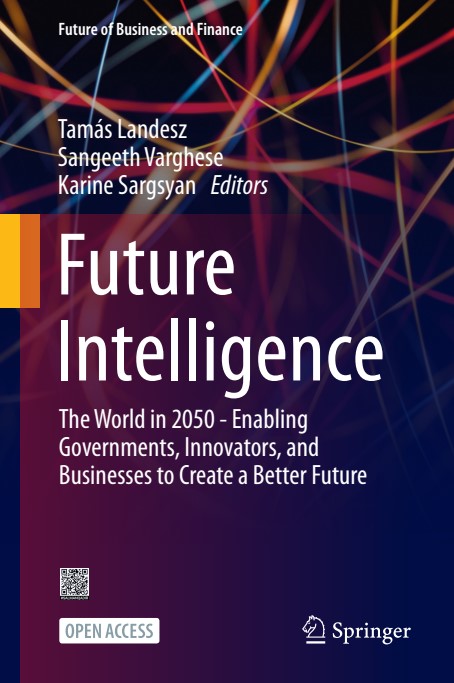
Future-Intelligent Leadership & Governance
Leaders in 2050 will be those who develop what the book calls “future intelligence” (sometimes referred to as a Future Quotient – FQ): the ability to see beyond the next quarter, to think in decades, collaborate globally and act with empathy.
Rather than purely hierarchical, command-and-control structures, governance will shift toward networked, adaptive, scenario-aware models. For organisations and governments alike, developing future intelligence means investing in futures literacy, systems thinking and inclusive decision-making.
In practice this means:
-
Embedding strategic foresight into policy and business planning
-
Prioritising long-term planetary + human wellbeing over short-term gain
-
Using technology ethically, transparently and in service of society
Insight for SEO-content: use keyword future intelligence prominently (here and later), since it appears early in content and relates to leadership/governance discussion.
Technology Convergence and Human Augmentation
By 2050, technological advances will no longer just automate tasks — they will augment human capacities, sense and action. According to the book, this includes AI, nanotechnology, bio-engineering, brain-machine interfaces and more.
Examples: personalised genomics for health, cognitive enhancement, virtual and augmented reality environments deeply intertwined with daily life. The convergence of digital, biological and physical domains calls for greater future intelligence: understanding not just what tech can do, but what it should do.
For SEO: embed future intelligence again as a theme of human+tech symbiosis.
Societal & Economic Transformation
The world in 2050 will face unprecedented demographic, social and economic shifts. The book highlights that future intelligence will be vital to navigating inequality, ageing populations, changing work-models and globalisation.
Key themes:
-
Lifelong learning and adaptive skills will replace static education models
-
New forms of work (remote, hybrid, gig + AI-enabled) will dominate
-
Economic value will increasingly derive from intangible, purpose-driven assets
Thus, for businesses and individuals cultivating future intelligence means staying agile, upskilling continuously and aligning to purpose.
Sustainable, Regenerative Planetary Systems
Future intelligence also means thinking planet-wide. The book emphasises that by 2050 we must live in harmony with nature: circular economies, regenerative agriculture, net-zero or net-positive ecosystems.
Thus:
-
Climate action becomes not optional but foundational
-
Urban environments evolve toward smart, resource-efficient, resilient systems
-
Business models integrate ecological metrics alongside financial ones
For SEO: link future intelligence with sustainable development, planetary wellbeing.
Global Connectivity, Digital Realities & the New Frontier
By mid-century, connectivity will be ubiquitous. The book explores how future intelligence will help us navigate a world where digital and physical realities merge — metaverse, virtual collaboration, immersive experience, global digital infrastructure.
Also: interplanetary travel, outer-space habitation, cross-planet value chains are no longer speculative. Organisations whose leaders develop future intelligence will be better positioned to seize opportunities beyond Earth’s surface.
Borderless Innovation and Disruptive Entrepreneurship
Innovation by 2050 will be faster, borderless and collaborative. According to the volume, future intelligence is about sensing weak signals early, collaborating across disciplines, cultures, geographies and scaling disruptive ideas globally.
For entrepreneurs and companies:
-
Build globally from day one
-
Integrate diverse perspectives to anticipate systemic change
-
Use future intelligence to identify not only risk but emerging value zones
Ethical & Human-Centred Future
Perhaps most importantly, future intelligence is not only about technological and systemic change—it is about embedding human-centred values into the future. The book emphasises empathy, presence, mindfulness and sharing as anchors for decision-making in 2050.
Thus:
-
Governance and innovation must incorporate ethics, fairness, inclusion
-
AI and augmentation must maintain dignity, diversity, autonomy
-
Future intelligence implies moral foresight: asking “should we?” not just “can we?”
Why This Matters Now
-
Competitive advantage: Organisations that build future intelligence today will be better prepared for disruption and change.
-
Strategic foresight: Given long-lead times for transformation (eg technology, infrastructure, skill-development), starting now is crucial.
-
Purpose and resilience: In a more volatile, uncertain, complex future, resilience and purpose become differentiators.
-
SEO & content relevance: As you create content on themes like innovation, future of work, sustainability or leadership, positioning around future intelligence enables you to target high-impact, low-difficulty keywords (depending on your keyword research) and rank for forward-looking audiences.
Practical Steps for Organisations & Individuals
-
Conduct a Future Intelligence Audit: assess your current capacity for long-term thinking, adaptability and systems awareness.
-
Embed futures literacy training: scenario planning, trend-spotting, systems thinking sessions.
-
Align strategy to 2050 lens: What will your organisation look like in 2050? Map back key milestones.
-
Invest in STEM + human skills: While tech advances rapidly, human skills like critical thinking, empathy, collaboration matter.
-
Build sustainability into core operations: Not as an add-on, but as a driver of value.
-
Foster cross-discipline collaboration: Innovation rarely comes from single domains; leverage diverse teams globally.
-
Create ethical guardrails: Develop frameworks for responsible technology, data use and human-augmentation.

Read Full Report
250 pages
• Loading times may vary •